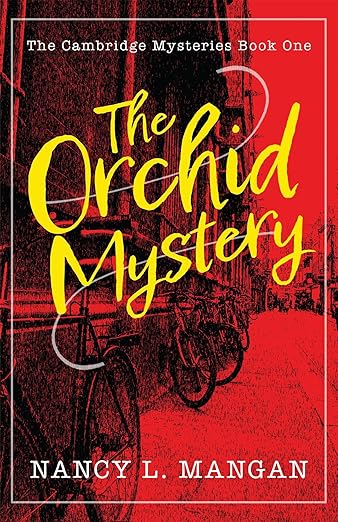
While I didn’t move to Cambridge until 1984, the city I arrived in still carried the atmosphere of the late 1970s. Close enough to 1977 for me to relate to it, and still in many ways untouched by the more sweeping changes that came later. It was the Cambridge I knew in my late twenties, and the Cambridge I chose as the setting for The Orchid Mystery.
Back then, the city felt gentle, walkable, and self-contained. It was a place where history wasn’t confined to college walls or chapel façades but ran under your feet and beside your bicycle wheels. There were fewer cars. The pace was slower. And there was something human-sized about it all. The skyline was still dominated by spires, not cranes. The shops were mostly independent. You knew where to get your bread, your coffee, your mended shoes. Nothing glittered, but everything felt solid.
The most visible change from the 1970s to the early 80s was the gradual redevelopment of the Kite area. At the time I moved to the city, the Grafton Centre had just been completed in its first phase. Back then, it reached only as far as the exit by the Old Druid’s Pub and the short-lived Presto’s supermarket, which closed in 1988. The rest came later. The expansion swallowed up old side streets and the remaining patchwork of terrace houses and corner shops. What had once been a quiet, slightly rundown residential area was replaced by a more modern shopping complex, but one still modest by today’s standards.
I was away from Cambridge for most of the 1990s, and when I returned, I was surprised by how little had changed. That is, until recently. Today, Cambridge is a different place. A city of bio labs, tech campuses, and start-ups, with house prices that feel surreal. The medieval bones remain, but they are dressed in glass and steel. That divide between town and gown still exists in subtle ways, but it no longer defines the city as sharply as it once did.
Back in the late 70s, it was unmistakeable. There was the university, with its wealth, formality, and rituals, and there was the town, home to those who made things work. I had a friend who worked as a bedder at one of the colleges. As a Kiwi, I found the name strange and the role even stranger; someone paid to tidy up after students, make beds, clean grates. It was a role steeped in hierarchy, but there was affection in it too. She knew who was up late, who had been crying, who was sneaking in boyfriends. It was all part of the unofficial undercurrent that kept the place human.
There was something about that Cambridge—a city suspended between ancient traditions and modern uncertainty—that made it the perfect backdrop for a mystery novel. That’s why The Orchid Mystery is set in 1977. It was a year on the cusp. Politically and socially, Britain was teetering. Strikes, inflation, and the long aftermath of the war still shadowed daily life. The glamour of the 60s had faded, and the Thatcher era had not yet begun. It was a moment of ambiguity, and ambiguity is fertile ground for fiction.
In Cambridge, those larger uncertainties were mirrored in the college cloisters and quiet courts. The university was slowly modernising, admitting more women and students from state schools, but the old ways lingered. There were whispered scandals, unspoken rules, and rooms that hadn’t been redecorated since before the war. What better place to hide a body, or a secret?
The city’s geography also played a role in the story. The winding alleys, the hidden gardens, the locked staircases that only Fellows had keys to, all of it helped build a world where mystery could breathe. In 1977, there were fewer cameras, less traffic, fewer distractions. People noticed things. Or didn’t. Silence was easier to come by.
When I walk through Cambridge today, I still see flashes of that older world. The light catching on college stone, the smell of warm paper in the university library, the clatter of a bicycle over cobblestones. But I also feel a sense of loss. The small shops are mostly gone, the city feels busier, shinier, more professional. The divide between past and present is harder to navigate.
So I return, through writing, to the Cambridge of 1977. A place of shadows and secrets. A place where the modern world was arriving, but hadn’t yet taken over. A place where a body found in a college garden would raise more questions than answers.

